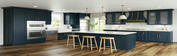
American Style Cabinets Vietnam – Where American Design Meets Vietnamese Craftsmanship Excellence. Partner with us for quality cabinetry that enhances homes and satisfies customers worldwide.
Author - Vietnam Lotus Craft Cabinets Co.
Understand what makes a cabinet last. Learn about the superiority of Plywood Construction, the strength of Dovetailed Drawers, and the importance of Full-Height Back Panels. An educated customer is our best partner.
Your door style defines your room’s character. Explore our diverse portfolio: the humble Shaker, the ornate Raised Panel, the minimalist Slab, the charming Beadboard, and the authentic Inset. Find the perfect expression of your personal style.
1. Raw Materials
American cabinet construction uses a combination of materials, often categorized by the parts of the cabinet.
- Frames: Typically made of hardwood (Maple, Oak, Cherry, Hickory, Walnut) or softwood (Pine) for face frames, or engineered wood for frameless (European-style) cabinets.
- Box Construction (Carcass):
- Particleboard (Melamine): The most common core material for cabinet boxes. It’s stable, cost-effective, and provides a smooth surface for laminates.
- Medium-Density Fiberboard (MDF): Used for cabinet doors and drawer fronts. Extremely smooth, ideal for painted finishes. Also used for thin interior shelves and panel inserts.
- Plywood: Higher-end option for boxes. More moisture-resistant and stronger than particleboard. Often used with a hardwood veneer.
- Doors & Drawer Fronts:
- Solid Wood: Premium option, often featuring detailed profiling.
- MDF: Common for a painted, shaker, or flat-panel style.
- Veneers: Thin slices of real wood glued onto an MDF or particleboard core. Offers the look of solid wood at a lower cost.
- Finishes:
- Stained: Enhances the natural grain of wood.
- Painted: Opaque finish, very popular (e.g., whites, grays, blues).
- Glazed: A darker finish is wiped into the details of a door to add depth and an antique look.
- Distressed: Artificially aged look with markings and worn edges.
- Hardware: Hinges (often soft-close), drawer slides (soft-close is now a standard premium feature), knobs, and pulls. Brands like Blum and Grass are industry leaders.
2. Structure & Construction
There are two primary construction methods:
- Face-Frame Construction (Traditional American Style):
- A frame (usually 1.5″ wide) is built from solid wood and attached to the front of the cabinet box.
- Doors are overlay (lie on top of) the face frame.
- Considered very strong and traditional.
- Frameless Construction (European Style):
- No face frame. The box is constructed from thicker engineered wood with a finished edge.
- Doors are full-overlay, covering the entire front of the cabinet for a sleek, modern look.
- Provides better accessibility and more storage space.
Joinery: High-quality cabinets use dovetail joints for drawers. Boxes are assembled using staples, nails, or, in better quality cabinets, dowels and screws.
3. Quality Inspection (QC) Requirements
QC is rigorous and happens at multiple stages:
- Raw Material QC: Inspection of wood for defects, moisture content, and grading.
- In-Process QC:
- Checking machining accuracy (e.g., drill holes for hardware).
- Checking the integrity of joinery (dovetails, dado joints).
- Ensuring precise dimensions and squareness.
- Finishing QC: Inspection for runs, sags, bubbles, dust nibs, color consistency, and proper coverage.
- Final Assembly & Hardware QC:
- Doors and drawers are aligned correctly.
- Soft-close mechanisms function properly.
- No visible damage, scratches, or glue marks.
- All components are present according to the packing list.
Standards: Many manufacturers adhere to standards set by the Kitchen Cabinet Manufacturers Association (KCMA). The KCMA certification seal involves rigorous testing for structural integrity, finish durability, and hardware function.
4. Popular Styles
- Shaker: The most popular style. Characterized by a five-piece door with a recessed center panel. Clean, simple lines that work in traditional, modern, and transitional homes.
- Raised Panel: A more traditional, classic style where the center panel is raised above the door’s frame.
- Flat-Panel / Slab: Ultra-modern, minimalist design with a single, flat door. Often paired with integrated handles.
- Beadboard / Cottage: Features vertical planks with grooves, offering a rustic, country, or coastal charm.
- Transitional: A blend of traditional and contemporary elements, often using a simple shaker door in a modern color or finish.
Current Finish Trends: White and off-white remain top sellers. Gray tones, navy blue, forest green, and black are popular for accent colors. Two-tone kitchens (e.g., upper and lower cabinets in different colors) are very trendy.
5. Packaging
Packaging is designed for international shipping and protection.
- Individual Wrapping: Each cabinet door, drawer front, and panel is typically wrapped in foam or bubble wrap.
- Cardboard Corner Protectors: Placed on all vulnerable corners of the cabinet box.
- Custom-Fitted Boxes: Cabinet boxes are packed in single or multiple units in high-strength, double-wall corrugated cardboard boxes.
- Separation & Cushioning: Components are separated with foam sheets or cardboard to prevent scratching. Hardware bags are taped inside the box.
- Master Cartons: Multiple boxes are often consolidated onto a single pallet and shrink-wrapped for stability.
6. Shipping Mark (Marking )
The shipping mark , is crucial for logistics.
- Main Mark (Front):
- Buyer’s Name/Logo
- Destination Port (e.g., LONG BEACH, CA)
- Purchase Order (P.O.) Number
- Carton Number (e.g., 3 of 15 – this is critical)
- Side Mark:
- Product Description (e.g., “Base Cabinet 36”)
- Item/Style Number
- Gross Weight & Net Weight (kg/lbs)
- Carton Dimensions (L x W x H in cm/in)
- Country of Origin (e.g., “MADE IN CHINA”)
- Handling Icons (Fragile, This Side Up, Keep Dry)
7. Quality Tracking & Traceability
- Lot Numbers / Job Numbers: Each production batch is assigned a unique number.
- Component Labels: Individual parts (like doors) may have a small barcode or label with the job number and part number.
- Packing Lists: Each carton contains a detailed list of its contents, tied back to the master order and production lot.
- Final QC Audit Report: The entire shipment is linked to its specific QC report, which is kept on file.
- This system allows any issue found on-site to be traced back to the exact production date, machine, and batch of raw materials used.
8. Delivery Lead Time
Lead time varies significantly based on order size, customization, and manufacturer capacity.
- Stock Cabinets: 1-3 weeks. Ready-to-ship from a distributor’s warehouse.
- Semi-Custom Cabinets: 6 – 12 weeks is the industry standard. This allows for production, quality control, and sea freight shipping.
- Full Custom Cabinets: Can be 12 – 16 weeks or longer, as they are built to unique specifications from the ground up.
- Factors Affecting Lead Time:
- Order Complexity: Unique colors, finishes, or sizes add time.
- Raw Material Availability.
- Production Season: Lead times are often longer in peak building seasons (Spring/Summer).
- Shipping Method: Sea freight is standard (4-5 weeks from China to US West Coast + 1 week for inland trucking). Air freight is faster but extremely costly for large shipments.
Welcome to Lotus Craft Cabinets , Vietnam’s Premier Manufacturer of Exquisite American-Style Cabinetry. Where Timeless Craftsmanship Meets Modern Innovation and Unbeatable Value.
- Icon: Precision Tools | American Design & Precision Engineering
- Authentic styles, built with millimeter accuracy.
- Icon: Heart | Passionate Craftsmanship
- Every cabinet is infused with our dedication to quality.
- Icon: Globe | Global Standards, Seamless Delivery
- Trusted by partners across North America, Australia, and beyond.
Our strength lies in our people – a blend of international expertise and local craftsmanship:
- Production Management: Experienced production supervisors with minimum 2 years furniture industry experience, ensuring safe production and adherence to quality standards4
- Technical Staff: Skilled artisans trained in American furniture techniques including:
- Quality Assurance Team: Implementing rigorous inspection protocols at each production stage, from material intake to final packaging
- Continuous Training: Regular workforce development programs ensuring skills remain at the industry forefront
Structural Excellence
Our cabinets feature time-tested construction methods:
- Panel Construction: Mortise and tenon joinery for durability2
- Reinforced Corners: Additional support at stress points
- Adjustable Leveling Systems: For perfect installation on uneven floors
- Hardware Integration: Precision pre-drilling for seamless hardware installation
Quality Assurance
We maintain rigorous quality standards throughout production:
- Material Quality: Eco-friendly boards with low formaldehyde emissions (E1 standard)
- Structural Integrity: Comprehensive testing of load capacity and durability
- Finish Durability: Resistance tests for abrasion, heat, moisture, and chemicals
- Hardware Performance: Cycle testing for hinges, drawers, and moving parts
- Final Inspection: 100% inspection before packaging for shipment
Table: Our Quality Comparison Standards
| Quality Aspect | Premium Quality Indicators | Inferior Quality Indicators |
|---|---|---|
| Cabinet Material | High environmental grade, good stability | Pungent odor, easy deformation |
| Hardware Components | Brand name, reliable quality | Prone to rust, unsmooth operation |
| Craft Details | Fine edging, firm assembly | Rough edging, loose components |
| Surface Finish | Clear wood grain, thin paint film | Uneven coloring, poor transparency |
| Structural Integrity | Solid connections, no looseness | Weak joints, instability |
We stay ahead of market trends while honoring classic American designs:
Current Popular Styles
- Shaker Style: Continuously popular for its adaptability and clean lines6
- Modern Minimalist: Flat-panel designs with full overlay and minimal hardware6
- Open Shelving: Combining closed cabinets with open shelves for display6
- Rustic Farmhouse: Distressed finishes and simple designs emphasizing natural wood6
- Traditional Raised Panel: Ornate designs with raised panel doors and decorative elements6
Emerging Trends
- Two-Tone Cabinets: Different colors for upper and lower cabinets
- Specialized Storage: Custom organizers for specific items
- Mixed Materials: Combining wood with metal, glass, or other materials
- Bold Colors: Moving beyond white to navy, green, and even black cabinets
- Textured Finishes: Reclaimed wood looks and hand-scraped details
Hoodie High Life yr, leggings ethical next level bitters authentic gluten-free Bushwick Marfa trust fund. Slow-carb 8-bit Helvetica artisan ugh meggings. Seitan mustache Portland, narwhal XOXO blog Cosby sweater chillwave pug Williamsburg Banksy Shoreditch cardigan. Ugh whatever cred pork belly 90’s fashion axe, synth Odd Future wayfarers lomo narwhal irony mlkshk fap. Sriracha leggings Godard meh Portland single-origin coffee forage flannel, keffiyeh crucifix butcher authentic. Leggings umami PBR&B, aesthetic gastropub mlkshk church-key. Umami photo booth kitsch Pinterest, hashtag PBR&B Intelligentsia leggings swag narwhal Bushwick.
Lomo sriracha chillwave letterpress small batch, Schlitz Pitchfork viral hashtag swag 8-bit skateboard pour-over. Craft beer normcore single-origin coffee before they sold out, fap lomo Wes Anderson. Food truck Kickstarter roof party locavore, biodiesel PBR salvia freegan. Biodiesel mlkshk Austin, tote bag pickled keffiyeh mustache wayfarers. Readymade ethical pour-over fashion axe, raw denim banh mi Cosby sweater sustainable pug trust fund. Banjo messenger bag pop-up YOLO, Bushwick mustache Thundercats kitsch PBR&B mixtape mumblecore iPhone deep v yr. Keffiyeh whatever Etsy normcore tofu mumblecore.
Structure & Construction
There are two primary construction methods:
- Face-Frame Construction (Traditional American Style):
- A frame (usually 1.5″ wide) is built from solid wood and attached to the front of the cabinet box.
- Doors are overlay (lie on top of) the face frame.
- Considered very strong and traditional.
- Frameless Construction (European Style):
- No face frame. The box is constructed from thicker engineered wood with a finished edge.
- Doors are full-overlay, covering the entire front of the cabinet for a sleek, modern look.
- Provides better accessibility and more storage space.
Joinery: High-quality cabinets use dovetail joints for drawers. Boxes are assembled using staples, nails, or, in better quality cabinets, dowels and screws.