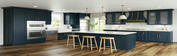
Detailed Production Process
Our manufacturing process combines advanced technology with skilled craftsmanship to ensure every cabinet meets the highest standards of quality and durability.
1. Material Selection & Preparation
We use carefully selected woods including solid wood, particle board, and MDF5. All materials undergo strict quality checks:
- Wood Drying: We control moisture content to 8-9% for Northern markets and 10-12% for Southern markets2
- Thickness Planning: Rough boards are planed to precise thickness (typically 20-22mm) using double-sided planning equipment2
- Width Calibration: Boards are cut to required widths (normally 70-120mm) with multi-blade saws2
2. Panel Processing
- Panel Jointing: Wood panels are joined to enhance stability and eliminate defects2
- Thickness Sanding: Calibrated sanding ensures uniform thickness across all components2
- CNC Processing: Our advanced 4-process CNC machining centers perform cutting, engraving, milling, grooving, and drilling with ±0.3mm precision3
3. Component Fabrication
- Four-sided Planning: Components are processed through four-sided planers for smooth surfaces and consistent profiles2
- Mortise and Tenon Joinery: Traditional mortise and tenon joints are created for durability2
- Milling: Single spindle milling machines shape components with precision2
- Sanding: Interior grooves are sanded to prevent splintering and ensure perfect finish2
4. Assembly
- Frame Assembly: Four-border frames and core panels are assembled using inserted tenons , glue, and adhesive particles2
- Dimension Control: Heavy-duty double-end milling machines ensure dimensional accuracy within ±0.2mm2
- Hardware Installation: Hinge holes and hardware components are precisely installed2
- Conditioning: Assembled doors are placed in dehumidification rooms to stabilize moisture content2
5. Finishing Process
Our American-style finishing involves multiple steps for that perfect vintage look10:
- Distressing: Artisanal techniques including wormholes, knife marks, ponytail marks, hammer marks, and spray spots create authentic antique effects10
- Toning: Professional technicians apply toners to even out wood color variations10
- Overall Coloring: Alcohol-based stains, non-fuzzing stains, penetrating pigment stains, oil stains, and dye stains create the base color10
- Filling: Pigmented fillers enhance wood grain clarity while filling pores10
- Glazing: Antiquing glazes create soft effects, contrasts, and shadows for classical interest10
- Top Coating: Final clear coats provide protection and enhance beauty10
- Polishing & Waxing: Surfaces are polished to perfection for exceptional smoothness10
Table: Quality Control Standards Throughout Our Production Process
| Production Stage | Quality Metrics | Tolerance Standards |
|---|---|---|
| Material Selection | Moisture content, defect detection | ±0.5% moisture content |
| Cutting Process | Dimensions, squareness | ±0.3mm length/width |
| Drilling Operations | Hole positioning, depth | ±0.2mm positioning |
| Sanding Quality | Surface smoothness | No cross-grain scratches |
| Finish Application | Coating thickness, uniformity | 0.1-0.15mm thickness |
